Projects › Agile in Education
Project · since 2016
Agile in Education
Learning in short cycles, with progress everyone can see and a fixed moment to adjust course.
The project
What it is
Agile in Education applies working methods from Scrum to learning. It rests on the Agile Learning Model, which connects Scrum with psychological principles for learning that starts from the learner. The model has five parts: trust, collaboration, visible feedback and reflection, culture, and working iteratively, meaning in short rounds that each end with looking back and adjusting.
Why the model is built this way. A Scrum board on the classroom wall does not make a class agile. A school that introduces agile as a teaching format ends up with a board that turns into a checklist and a stand-up that turns into a moment of control. That is why trust and culture are parts of the model, not preconditions the school is expected to sort out first.
Who with. Guido van Dijk, director of LeX, is the originator and author of the Agile Learning Model. He researched it and developed it further as a PhD candidate at the Welten Institute of the Open University of the Netherlands. In 2016 he co-founded AgileInEducation (opens in a new window). Through LeX we have worked with, among others, Leysin American School (opens in a new window) in Switzerland and Agile Classrooms (opens in a new window).
Role of LeX. LeX designs and runs the workshops, and applies the model to the question of the school or partner.
The compass
The Agile in Education Compass
In April 2016 a group of agile educators from several countries met at the Scrum Gathering in Orlando, Florida. Together they created the Agile in Education Compass. Guido van Dijk was one of its thirteen creators.
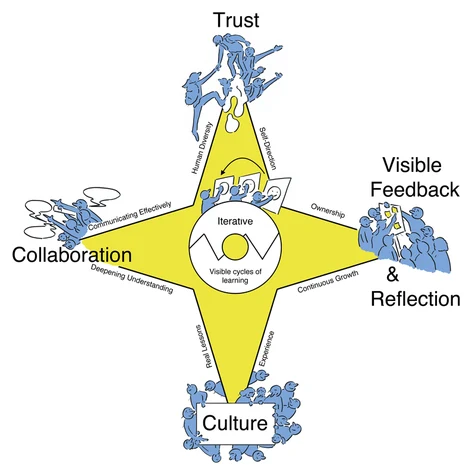
The compass describes five shifts in how education is organised. The five parts of the Agile Learning Model build on them.
Together, we are discoverers of the world and ourselves. The world is no longer predictable, so learning needs to be more adaptive, connected and interdependent. Along the way new paths unfold, towards learning that is authentic to the learner. The compass helps to navigate them.
- From prescriptive to iterative. Visible cycles of learning. Making intentions explicit and visible fosters partnerships, and allows meaningful and relevant education to emerge.
- From content to culture. Learning starts with why: the big story. The real lessons of life are embedded in experience.
- From evaluation to visible feedback and reflection. Nurturing the love of lifelong learning. Partnering in a learning journey catalyses continuous growth and ownership.
- From control to trust. Valuing the freedom of discovery. Providing space for human diversity increases agency and self-direction.
- From competition to collaboration. The power of shared learning. Sharing the individual perspective develops the social intelligence needed to solve problems, communicate effectively and deepen understanding.
The original, in English, Spanish and German, is at agileineducation.org (opens in a new window).
Result
What it produced
A model that has been researched, not only conceived. And a two-day workshop, Agile in Education, in which teams apply the model to their own teaching.
How to work with us
- Half-day. A masterclass on the Agile Learning Model, for a team or a school leadership group.
- Multi-day programme. The two-day workshop Agile in Education. Each participant designs a first cycle for their own lesson, department or team.
If the question turns out to be about the timetable, grouping or assessment, it is no longer a workshop question. It then continues as education transition.